
India, Israel, and the New Fault Lines of West Asia
India’s relationship with Israel has entered a more consequential and more exposed phase than at any point since full diplomatic ties were established in 1992. What once looked like a pragmatic partnership built around defense, agriculture, technology, and counterterrorism has now become a visibly political alignment shaped by the wider war in West Asia. The conflict between Israel and Iran has not only redrawn the region’s security map; it has also forced India to confront the costs and contradictions of its own foreign policy choices. The consequences are being felt in strategic corridors from Tel Aviv to Tehran, but also in Indian streets, homes, markets, and political debates.
Modi’s Israel Visit and the Shift in Indian Foreign Policy
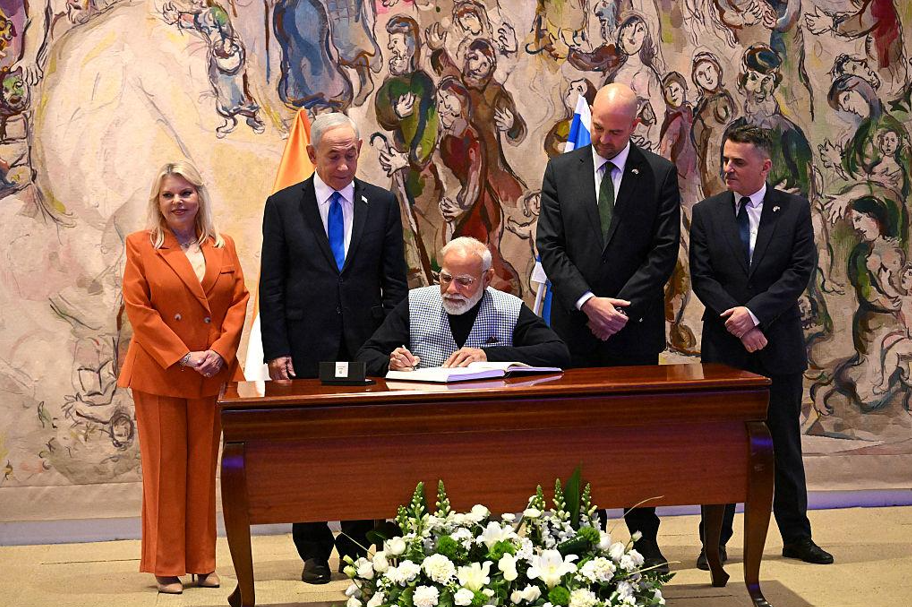
The most striking symbol of this shift was Prime Minister Narendra Modi’s February 2026 visit to Israel and his address to the Knesset. The trip was historic not just because of its ceremonial importance, but because of its timing. Modi’s appearance in Jerusalem, where he pledged that India stood with Israel “firmly, with full conviction,” signaled a deeper comfort with open alignment than India had historically shown in West Asia. For decades, India tried to preserve a careful balance: supporting Palestinian statehood, maintaining ties with Iran, and deepening relations with Israel without fully abandoning its non-aligned instincts. That balancing act now appears increasingly difficult to sustain.
The Strategic Foundations of the India-Israel Partnership
The India-Israel partnership has long been rooted in hard interests. Israel has supplied India with battlefield-tested drones, surveillance systems, air defense platforms, and cyber tools. During crises, such as the Kargil War in 1999, a limited conflict between India and Pakistan in Kashmir, and later the 2025 confrontation with Pakistan after the Pahalgam attack, Indian forces relied heavily on Israeli-origin equipment. The relationship has also expanded into agriculture, water management, startup innovation, and joint industrial production. In practical terms, Israel has become one of India’s most dependable defense partners. For New Delhi, that matters because India wants technology, resilience, and quick access to high-end military systems. For Israel, India offers a massive market, diplomatic legitimacy, and a growing Asian partner that can help soften its global isolation.
Iran, Energy Security, and the Diplomatic Costs
But the war with Iran has exposed the fragility beneath this partnership. India’s tilt toward Israel now carries costs that are both external and internal. Externally, India’s standing in Iran has collapsed. The Chabahar port project, once marketed as a strategic bridge to Afghanistan and Central Asia, has lost momentum and the broader deterioration of India-Iran trust. Energy security has also become a serious vulnerability. A closure of the Strait of Hormuz, through which a major share of India’s crude oil and LNG imports pass, can quickly shake prices, inflation, transport, fertilizer supplies, and industrial costs. In a country as import-dependent as India, geopolitical alignments are no longer abstract; they affect the price of cooking gas, diesel, food, and power.
Pakistan’s Diplomatic Position and India’s Strategic Dilemma
At the same time, the war has created a new diplomatic asymmetry. Pakistan, long seen by India as a regional adversary and a sponsor of instability, has managed to present itself as a mediator in parts of the West Asian crisis. That matters symbolically. India has spent years trying to claim a larger role in global affairs, yet in this conflict it has often appeared reactive, not influential. Its silence on key moments of the war, its caution in multilateral forums, and its reluctance to challenge the US-Israel campaign against Iran have led critics to argue that strategic autonomy has become strategic hesitation. Supporters of the government counter that India is simply acting on national interest, preserving defense cooperation with Israel and protecting its links with the US-led order. Both claims contain truth, but the tension between them is now impossible to ignore.
The Human Dimension: Migration, Labor, and Society
The human dimension of this relationship is equally important. India-Israel ties are no longer confined to governments and generals. They now shape labor mobility, student exchanges, tourism, and digital collaboration. Tens of thousands of Indian workers are expected to find employment in Israel over the coming years, especially in construction and care sectors. For many Indian families, Israel is no longer just a distant strategic partner; it is a place of wages, opportunity, and future mobility. That people-to-people layer gives the relationship real depth, but it also makes it more sensitive. When war intensifies, the risks to workers, travelers, and families rise quickly. Indian society begins to feel events in West Asia not only through television headlines, but through remittances, job markets, and migration anxieties.
Kashmir, Palestine, and the Politics of Solidarity
The aftermath of the war has also sharpened political and communal debates inside India. Nowhere has this been more visible than in Kashmir. The Kashmir Valley has long expressed sympathy for the Palestinian cause, and the Gaza war has deepened those emotions. Public demonstrations carrying Palestinian flags, images of Lebanese and Palestinian leaders, and slogans denouncing Israel have triggered strong state responses. Authorities have used the Unlawful Activities (Prevention) Act, India’s main anti-terror law, against protesters and organizers, shut mosques on sensitive days, and treated pro-Palestine mobilization as a law-and-order threat. For many Kashmiris, the comparison with Palestine is emotional and political: both are seen through the lens of occupation, repression, and collective punishment. That parallel has become even more powerful since the revocation of Article 370 in 2019, the constitutional provision that had granted Jammu and Kashmir limited autonomy until its revocation, which many in the valley experienced as a historic loss of autonomy.
Domestic Contradictions and the Question of Double Standards
This is where India’s Israel policy becomes domestically complicated. A government that deepens ties with Israel while intensifying restrictions on political expression in Kashmir risks reinforcing perceptions of double standards. Kashmiri leaders, including mainstream figures, have condemned the suffering in Gaza and Lebanon, while many residents see India’s close embrace of Israel as proof that New Delhi is willing to side with states accused of harsh military conduct against Muslim populations. That sentiment does not automatically translate into militancy, but it does deepen alienation. In a region already burdened by decades of conflict, symbolism matters enormously.
The Lucknow Incident and India’s Communal Fault Lines
The Lucknow incident, a politically charged communal controversy that intensified debate over religion, policing, and political speech in India, added another layer to this domestic tension. In the Indian public imagination, Lucknow often represents an urban center where religious identity, political speech, and state power intersect. The incident there, which drew attention because of its communal overtones and the way it was framed in public debate, became part of the broader argument about how global conflicts are filtering into Indian society. Whether through protests, speeches, social media, or political mobilization, the Israel-Gaza-Iran war is increasingly being read through Indian communal lenses. In some circles, support for Palestinians is being equated with extremism; in others, support for Israel is seen as evidence of majoritarian bias. Lucknow, like Kashmir, became a reminder that foreign policy is no longer happening far away. It is being absorbed into India’s internal fault lines.
Social Cohesion, Security, and Strategic Interests
That is why the impact of the war on India cannot be measured only in barrels of oil or defense contracts. It is also a test of social cohesion. The government’s strong security response to pro-Palestine sentiment may bring short-term control, but it also risks aggravating mistrust among Muslim citizens who already feel politically marginalized. At the same time, the strategic partnership with Israel continues to produce benefits that New Delhi does not want to lose. India wants advanced military technology, cooperation on drones and cyber systems, agricultural innovation, and access to Western-led strategic frameworks such as I2U2 and IMEC. Israel offers all of that. The question is not whether the partnership matters, but whether India can preserve it without paying too high a domestic and diplomatic price.
India’s Moral Posture and the Crisis of Balance
The war has also forced a reassessment of India’s moral posture. For years, India tried to speak in the language of balance: condemning terrorism, supporting a two-state solution, and maintaining multiple friendships at once. But when the crisis sharpened, that balance looked less like principle and more like ambiguity. India’s support for Palestinian statehood remained in formal documents, but its diplomatic behavior increasingly signaled alignment with Israel and the United States. That may deliver short-term strategic rewards, but it also narrows India’s room to speak credibly to the Arab world, to Iran, and to parts of its own population.
Conclusion: What Kind of Power Does India Want to Be?
In the end, the Israel-Iran war has shown how central Israel has become to India’s strategic thinking. Defense cooperation, technology partnerships, and growing political alignment have pushed India-Israel relations into a far deeper phase than before. At the same time, India does not want to become part of any rigid geopolitical camp. New Delhi still seeks to balance its ties with Israel alongside its relationships with Iran, the Gulf states, and the wider Arab world.
Despite the visible shift in public policy toward Israel, India continues to present itself as a country that values dialogue and strategic autonomy. Its long-standing ties across West Asia give it the potential to support or even encourage future peace negotiations, although it has so far avoided taking an active mediating role in the conflict.
The larger challenge for India will be maintaining this balance as regional tensions grow sharper. The war has made it clear that developments in West Asia are no longer distant events for India; they now directly shape its diplomacy, economy, and domestic politics.